• About
  • Contents
  • Tag Cloud

Temple Study

Sustaining and Defending the LDS Temple

Scholarship

King Charlemagne in Royal Apparel
April 19, 2008 by Bryce Haymond 4 Comments

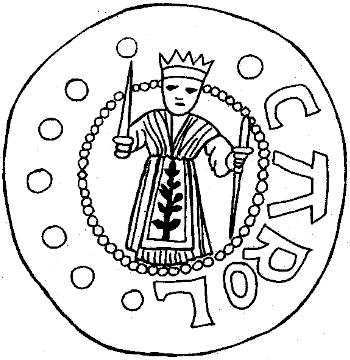
Coin of Charles the Great (ca. 742-814 A.D.)

This unique coin is from sometime between 742 and 814 A.D. and depicts Charles the Great, also known as Charlemagne, arrayed in his royal apparel. Matthew Brown describes it thus:

…wearing a crown, a pleated robe, and an apron that is decorated with a tree. The king also holds the sword, which in ancient times was regarded as a royal weapon. ((Matthew Brown, The Gate of Heaven, 127.))

Diane Wirth, a writer and lecturer on Mesoamerican iconography, describes the design on this apron as the “Tree of Life” ((Diane Wirth, “The King and the Tree of Life: Evidence of Pre-Columbian Contact,” 2003 BMAF Conference, <http://www.bmaf.org/page.php?cmd=view&id=57>.)). Brown corroborates when he says that the king himself, in the ancient Near East, was often seen as a “personification of that tree” ((Matthew Brown, Girded About with a Lambskin, FARMS, <http://farms.byu.edu/display.php?id=149&table=jbms>.)).

Brown continues that “Since the king of Israel was considered to be the personification of Adam…, we might ask whether his apron somehow imitated the fig leaf apron that was worn by Adam (see Genesis 3:7)” ((Matthew Brown, The Gate of Heaven, 150)). Furthermore, “ancient Hebrew legends . . . taught that the tree of knowledge of good and evil was a fig tree and it was from this tree’s leaves that Adam constructed his apron” ((Matthew Brown, Girded About with a Lambskin, FARMS, <http://farms.byu.edu/display.php?id=149&table=jbms>.)).

Another image of Emperor Charlemagne (see figure 297) likewise shows him wearing such plantlife iconography, whether trees or leaves, upon his breast ((Paul Lacroix, Manners, Custom and Dress During the Middle Ages and During the Renaissance Period, <http://www.gutenberg.org/files/10940/10940-h/10940-h.htm>.)).

Posted in: Artifacts, Scholarship Tagged: apron, charlemagne, charles the great, clothing, king, near east, robes, royalty, vestments

Early Byzantine Veil with Gammadia

April 17, 2008 by Bryce Haymond 6 Comments

Early Byzantine Veil in Agios Eleftherios church, AthensLast night a reader referenced me to what appears to be a new blog by Bill Hamblin, a well-known LDS scholar and Associate Professor of History at BYU, and particularly about a post of his of a couple week ago. Dr. Hamblin talks about early Byzantine veils, and especially one that he has photographs of in an old church, the Agios Eleftherios, in Athens.

We have examined the iconostasis on this blog previously, an icon wall which stemmed from an earlier chancel screen or templon, a barrier or partition which separated the holy area where only the priests could go from the area of the laity.

This ancient Athens church retains its original chancel screen, including a curtain or veil. This veil is particularly interesting in that it includes the original gammadia marks, right-angled symbols like the Greek letter gamma (Γ), which we’ve also mentioned before. As Dr. Hamblin notes, these gammadia were often used to mark veils, altar cloths, and priestly robes in early Byzantine Christianity. Almost all of these veils have now been replaced by iconostases in modern churches.

Read the whole post at Bill Hamblin’s Things Unutterable. Thanks Reed!

Posted in: Artifacts, Scholarship Tagged: altar, bill hamblin, celestial room, chancel screen, gammadia, holy of holies, iconostasis, marks, photographs, photos, robes, symbols, templon, veil

Crowns with Strings, Ribbons, & Lappets

April 16, 2008 by Bryce Haymond 5 Comments
Ancient Crowns: (left to right) Assyrian (Sennacherib), Assyrian (Sardanapalus III), Syrian (Tigrames), Assyrian (Nineveh), Persian (Persepolis). From www.bible-history.com/sketches/ancient/crowns.html

Ancient Crowns: (left to right) Assyrian (Sennacherib), Assyrian (Sardanapalus III), Syrian (Tigrames), Assyrian (Nineveh), Persian (Persepolis). From www.bible-history.com/sketches/ancient/crowns.html

There is an interesting passage, of many, in Matthew Brown’s study of the temple, The Gate of Heaven, that caught my attention with regard to ancient crowns:

It is not known exactly what type of crown was worn by the Israelite kings, but we do know that the high priest of the temple wore a crown of pure gold. A single cord, string, or line (pathil) was used to secure the golden crown of the high priest onto the front of his white linen headress (see Exodus 28:36-38; Leviticus 8:9). This particular cord was dyed blue (see Exodus 28:36-37), suggesting by its color that it was symbolic or royal or heavenly status. It is presumed that this cord was tied off at the back of the head and its excess end or ends hung down freely. Perhaps a parallel can be seen in the long, decorated ribbons or lappets that are so often depicted hanging from the back or sides of the crowns that were worn by the ancient kings of Assyria, Egypt, and other Near Eastern nations. ((Matthew Brown, The Gate of Heaven, 129.))

Brown adds a detail about these crowns in a fascinating note taken from Spencer J. Palmer’s book Deity and Death:

The kings of India participated in a ceremony called the rajasuya in order that they might obtain access to heaven. “The rajasuya is without doubt an ascension ritually accomplished. The very first element of it is the prayaniya, a term which translates into ‘ascension’ . . . The king is clothed in sacred garments (‘The garment is connected with all the gods,’ says an ancient text); the garments are said to be marked in special ways, representative of the ceremony undertaken by the king. The garment consists of several parts, one of which is worn on the head (Widengren’s crown), the ends of which are tied into the upper garment. Throughout the ritual the king is called by the name of the various gods whom he is impersonating. He is taken back into primordial time and performs the same functions symbolically which the gods and the first king did at that time, by virtue of which they obtained heaven…” ((Matthew Brown, The Gate of Heaven, 151-152.))

I was curious what a “lappet” was. Wikipedia’s definition:

A lappet is a decorative flap or fold in a ceremonial headdress or garment… They remain strongly associated with religion. A bishop’s mitre has two lappets (infulæ) sewn to the back of it. The most famous usage of lappets occurs on the Papal Tiara.

Posted in: Artifacts, Scholarship Tagged: ascension, clothing, crown, endowment, garments, lappets, near east, ribbons, rituals, string, tiara, vestments

Sacrifice Continues in the Temple

April 8, 2008 by Bryce Haymond 3 Comments

Adam and Eve at the altarOne of the criticisms leveled at the LDS (Mormon) practice of temple worship is the seemingly dissimilar forms of the ordinances when compared with those found practiced by ancient Israelites in the Bible. It is true that the forms of the ordinances and sacrifices are different, but their meaning and symbolism remain the same. Let us consider why the forms are different.

From Adam down to Moses, the Melchizedek priesthood, with its accompanying higher ordinances, were practiced by the covenant people of the Lord. These were similar in form to LDS temple worship today. Unfortunately, since most of the accounting from the Old Testament takes place from the time period of Moses to Christ, from the Bible we become most familiar with the lower ordinances that the Israelites practiced in the Tabernacle, Solomon’s Temple, Zerubbabel’s Temple, and Herod’s Temple. This is because when Moses desired to give the higher law of the gospel and the ordinances of the Melchizedek priesthood to his people they rebelled against him and the Lord withdrew these higher ordinances and instituted the lower Aaronic priesthood (including the Levitical priesthood) with its accompanying outwardly observances and performances. The Israelites were not worthy to come into the presence of the Lord as a whole; only the high priest was allowed into the most holy place in the Tabernacle, and only on certain prescribed days. These practices continued for 1200-1300 years, and the Israelites’ writings during this time fill a large measure of the Bible.

When Christ came to earth, he restored the Melchizedek priesthood with its accompanying higher ordinances. The Mosaic law was also fulfilled in Christ at that time, and the type of sacrifices performed in temples were consequently changed. Blood sacrifices were no longer required. Intermediary animals were also now not required. All of the Lord’s covenant people were able to approach the Lord directly and offer a self-sacrifice of their time, talents, and everything that they had, including the only true sacrifice we can give God, our individual will. The form of the sacrifice changed, but the meaning and symbolism remained exactly the same.

Yesterday and today, the ordinances and sacrifices offered in the Lord’s temples have always pointed to Jesus Christ and his ultimate sacrifice and atonement. The following table helps compare the types and forms of sacrifice offered in the temple of the Lord since Adam to the present day: ((Most of this information was gathered from Andrew Skinner’s Temple Worship, 121-125, 181-189)) [Read more…]

Posted in: Practices, Scholarship, Temples Today Tagged: aaronic, adam and eve, altar, andrew skinner, atonement, bible, consecration, herod, holy of holies, melchizedek, moses, ordinances, prayer, priesthood, sacrifice, solomon, symbols, tabernacle, vicarious

Temple as a Scale-Model of the Universe

April 4, 2008 by Bryce Haymond 27 Comments

Several scholars, both LDS and members of other faiths, have noted that the temple is a model of the universe:

  • The temple is a scale model of the universe… ((Hugh Nibley, Temple and Cosmos, 14-15))
  • …the temple represents the principle of ordering the universe. ((ibid.))
  • [The temple is] for the purpose of taking our bearings on the universe… ((ibid.))
  • …the temple reflects things as they exist in heaven-things as they really are. ((Andrew Skinner, Temple Worship, 2))
  • The temple embodies “the structure of the universe, so that ascent through the heavenly levels [is] also a journey ‘inward’ through the temple’s concentric areas of increasing holiness to the Holy of Holies at the center.” ((Qtd. in Matthew Brown, The Gate of Heaven, 7))
  • …the temple (whether earthly or heavenly) is a miniature imitation of the structure of the universe. ((ibid.))

God’s perception of time and space are incomprehensible to our mortal and finite minds (Isa. 55:8-9).  However, if the temple is an accurate model of the universe, then it should be possible to reproduce an approximate visual representation of the universe from what we learn from the temple, which is what I’ve attempted above. [Read more…]

Posted in: Scholarship, Temples Today Tagged: bruce r. mcconkie, hugh nibley, imitation, model, representation, solar system, structure, universe
« Previous 1 … 27 28 29 … 33 Next »

About TempleStudy.com

This blog is dedicated to the exemplary LDS (Mormon) scholar Dr. Hugh Nibley, whose landmark temple studies have strengthened the faith of many. Read more on About page. Email me. Click on the widget in the lower-right corner of the window to chat with me.

Support TempleStudy.com

Recent Comments

  • Miguel David Gedo on The Black Robes of a False Priesthood
  • ellen north on Pondering the Temple Experience Through Scripture
  • Corey on Who were the Shepherds in the Christmas Story?
  • Lori allred on Creed Haymond Story of the Word of Wisdom, in His Own Words
  • Aleta G on Homeward Bound: Interpretations of Marta Keen Thompson’s Music

Recent Posts

  • ThyMindOMan.com – Exploring the Mind’s Relationship to God
  • Videos of 2014 Temple on Mount Zion Conference Now Available for Free Viewing
  • Gratitude Precedes Zion
  • Official Church Video on Temple Garments and Robes
  • The Temple on Mount Zion 2014 Conference

Categories

  • Announcements
  • Artifacts
  • Church History
  • Favorites
  • General Authorities
  • Practices
  • Scholarship
  • Temples Today
  • Texts
  • Tidbits
  • Uncategorized

Archives

  • April 2017
  • November 2014
  • October 2014
  • June 2014
  • May 2014
  • April 2014
  • February 2014
  • November 2013
  • October 2013
  • September 2013
  • August 2013
  • July 2013
  • June 2013
  • May 2013
  • April 2013
  • March 2013
  • February 2013
  • January 2013
  • December 2012
  • November 2012
  • October 2012
  • September 2012
  • August 2012
  • July 2012
  • June 2012
  • December 2011
  • October 2011
  • April 2011
  • March 2011
  • February 2011
  • January 2011
  • June 2010
  • May 2010
  • April 2010
  • March 2010
  • February 2010
  • January 2010
  • December 2009
  • November 2009
  • October 2009
  • September 2009
  • August 2009
  • July 2009
  • June 2009
  • May 2009
  • April 2009
  • March 2009
  • February 2009
  • January 2009
  • December 2008
  • November 2008
  • October 2008
  • September 2008
  • August 2008
  • July 2008
  • June 2008
  • May 2008
  • April 2008
  • March 2008
  • February 2008
  • January 2008

Blogroll

  • Adventures in Mormonism
  • Believe All Things
  • Free Temple Photos Blog
  • Heavenly Ascents
  • Latter-Day Commentary
  • LDS Temples Photo Blog
  • Leen Ritmeyer – Archeological Design
  • Lehi’s Library
  • Millennial Star
  • Mormanity
  • Mormon Insights
  • Mormon Mysticism
  • Pronaos
  • Sacred Symbolic
  • Strong Reasons
  • Temple Photos Blog
  • The Seer Stone
  • Things Unutterable
  • Visions of the Kingdom

Links

  • Barry Bickmore: Temple in Early Christianity
  • Bruce Porter’s Temple Articles
  • BYU Students of the Ancient Near East (SANE)
  • FAIR Wiki
  • FAIRLDS: Mormon Research
  • FARMS: Mormon Scholarship
  • Jeff Lindsay: Temples and Masonry
  • Jesus Christ
  • LDS Church News
  • LDS Church Temples
  • LDS Temple Fine Art – Robert Boyd
  • LDS Temple Photography – Aaron Barker
  • LDS Toolbar.com
  • LDS Toolbar.net
  • LDS.org
  • LDS.org Temples
  • Mormon Church Temples
  • Mormon Conferences
  • Mormon Monastery
  • Mormon Temple Ceremony
  • Mormon Temple Ceremony
  • Mormon.org
  • Temple Prints Fine Art Photography
  • Temple Studies Group
  • The Temple Institute

Copyright © 2025 Temple Study.

Omega WordPress Theme by ThemeHall