“Everyone Wants a Prophet… But Not Really” at Millennial Star

Check my post at Millennial Star on “Everyone Wants a Prophet… But Not Really.”
Check my post at Millennial Star on “Everyone Wants a Prophet… But Not Really.”
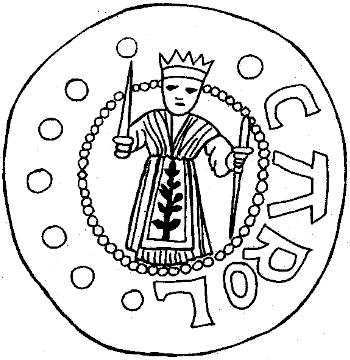
This unique coin is from sometime between 742 and 814 A.D. and depicts Charles the Great, also known as Charlemagne, arrayed in his royal apparel. Matthew Brown describes it thus:
…wearing a crown, a pleated robe, and an apron that is decorated with a tree. The king also holds the sword, which in ancient times was regarded as a royal weapon. ((Matthew Brown, The Gate of Heaven, 127.))
Diane Wirth, a writer and lecturer on Mesoamerican iconography, describes the design on this apron as the “Tree of Life” ((Diane Wirth, “The King and the Tree of Life: Evidence of Pre-Columbian Contact,” 2003 BMAF Conference, <http://www.bmaf.org/page.php?cmd=view&id=57>.)). Brown corroborates when he says that the king himself, in the ancient Near East, was often seen as a “personification of that tree” ((Matthew Brown, Girded About with a Lambskin, FARMS, <http://farms.byu.edu/display.php?id=149&table=jbms>.)).
Brown continues that “Since the king of Israel was considered to be the personification of Adam…, we might ask whether his apron somehow imitated the fig leaf apron that was worn by Adam (see Genesis 3:7)” ((Matthew Brown, The Gate of Heaven, 150)). Furthermore, “ancient Hebrew legends . . . taught that the tree of knowledge of good and evil was a fig tree and it was from this tree’s leaves that Adam constructed his apron” ((Matthew Brown, Girded About with a Lambskin, FARMS, <http://farms.byu.edu/display.php?id=149&table=jbms>.)).
Another image of Emperor Charlemagne (see figure 297) likewise shows him wearing such plantlife iconography, whether trees or leaves, upon his breast ((Paul Lacroix, Manners, Custom and Dress During the Middle Ages and During the Renaissance Period, <http://www.gutenberg.org/files/10940/10940-h/10940-h.htm>.)).
 Last night a reader referenced me to what appears to be a new blog by Bill Hamblin, a well-known LDS scholar and Associate Professor of History at BYU, and particularly about a post of his of a couple week ago. Dr. Hamblin talks about early Byzantine veils, and especially one that he has photographs of in an old church, the Agios Eleftherios, in Athens.
We have examined the iconostasis on this blog previously, an icon wall which stemmed from an earlier chancel screen or templon, a barrier or partition which separated the holy area where only the priests could go from the area of the laity.
This ancient Athens church retains its original chancel screen, including a curtain or veil. This veil is particularly interesting in that it includes the original gammadia marks, right-angled symbols like the Greek letter gamma (Γ), which we’ve also mentioned before. As Dr. Hamblin notes, these gammadia were often used to mark veils, altar cloths, and priestly robes in early Byzantine Christianity. Almost all of these veils have now been replaced by iconostases in modern churches.
Read the whole post at Bill Hamblin’s Things Unutterable. Thanks Reed!

Ancient Crowns: (left to right) Assyrian (Sennacherib), Assyrian (Sardanapalus III), Syrian (Tigrames), Assyrian (Nineveh), Persian (Persepolis). From www.bible-history.com/sketches/ancient/crowns.html
There is an interesting passage, of many, in Matthew Brown’s study of the temple, The Gate of Heaven, that caught my attention with regard to ancient crowns:
It is not known exactly what type of crown was worn by the Israelite kings, but we do know that the high priest of the temple wore a crown of pure gold. A single cord, string, or line (pathil) was used to secure the golden crown of the high priest onto the front of his white linen headress (see Exodus 28:36-38; Leviticus 8:9). This particular cord was dyed blue (see Exodus 28:36-37), suggesting by its color that it was symbolic or royal or heavenly status. It is presumed that this cord was tied off at the back of the head and its excess end or ends hung down freely. Perhaps a parallel can be seen in the long, decorated ribbons or lappets that are so often depicted hanging from the back or sides of the crowns that were worn by the ancient kings of Assyria, Egypt, and other Near Eastern nations. ((Matthew Brown, The Gate of Heaven, 129.))
Brown adds a detail about these crowns in a fascinating note taken from Spencer J. Palmer’s book Deity and Death:
The kings of India participated in a ceremony called the rajasuya in order that they might obtain access to heaven. “The rajasuya is without doubt an ascension ritually accomplished. The very first element of it is the prayaniya, a term which translates into ‘ascension’ . . . The king is clothed in sacred garments (‘The garment is connected with all the gods,’ says an ancient text); the garments are said to be marked in special ways, representative of the ceremony undertaken by the king. The garment consists of several parts, one of which is worn on the head (Widengren’s crown), the ends of which are tied into the upper garment. Throughout the ritual the king is called by the name of the various gods whom he is impersonating. He is taken back into primordial time and performs the same functions symbolically which the gods and the first king did at that time, by virtue of which they obtained heaven…” ((Matthew Brown, The Gate of Heaven, 151-152.))
I was curious what a “lappet” was. Wikipedia’s definition:
A lappet is a decorative flap or fold in a ceremonial headdress or garment… They remain strongly associated with religion. A bishop’s mitre has two lappets (infulæ) sewn to the back of it. The most famous usage of lappets occurs on the Papal Tiara.

Today in priesthood we talked about chapter 7 in the Joseph Smith manual. It is about “Baptism and the Gift of the Holy Ghost.” One thing that struck me as I read the chapter is the number of times that Joseph referred to baptism and some of the other principles and ordinances as signs:
God has set many signs on the earth, as well as in the heavens…
Upon the same principle do I contend that baptism is a sign ordained of God, for the believer in Christ to take upon himself in order to enter into the kingdom of God…
It is a sign and a commandment which God has set for man to enter into His kingdom. Those who seek to enter in any other way will seek in vain; for God will not receive them, neither will the angels acknowledge their works as accepted, for they have not obeyed the ordinances, nor attended to the signs which God ordained for the salvation of man, to prepare him for, and give him a title to, a celestial glory…
Baptism is a sign to God, to angels, and to heaven that we do the will of God, and there is no other way beneath the heavens whereby God hath ordained for man to come to Him to be saved…
The Lord says do so and so, and I will bless you. There are certain key words and signs belonging to the Priesthood which must be observed in order to obtain the blessing. The sign [taught by] Peter was to repent and be baptized for the remission of sins, with the promise of the gift of the Holy Ghost…
…but he could not receive the gift of the Holy Ghost until after he was baptized. Had he not taken this sign or ordinance upon him, the Holy Ghost which convinced him of the truth of God, would have left him.
I think this is enlightening. All of the ordinances and covenants of the gospel include (and are) signs. Signs are physical actions which demonstrate to God that we have, indeed, entered into the covenants that we say we have. We can’t just say we’ve made a covenant with God with our lips (which is what God said in the First Vision was occurring in the world – “they draw near to me with their lips, but their hearts are far from me” (JS-H 1:19). Whenever true covenants are made with God, established physical signs have accompanied them.
The sign of baptism is the physical action of being immersed in the water. The sign of receiving the gift of the Holy Ghost is the laying on of hands, as is ordination to the priesthood. The sign of the sacrament is the blessing, administering, and partaking of the emblems or symbols of Christ’s flesh and blood. The sign of blessing the sick or afflicted is the anointing with consecrated oil and the laying on of hands. The sign of the sealing ordinance in the temple is kneeling at the altar with your spouse and other sacred actions. The signs of the covenants of the endowment are likewise recognizable to those who have participated in them.
Because these signs always are physical, perhaps that is one of the reasons that a disembodied spirit cannot perform them alone. They must be done vicariously, or by proxy, by a living person, one who can perform these signs with a physical body in behalf of the dead.